Creating alignment and empathy before designing the solution.
Notifications for hospital admission, discharge and transfer (ADT) and behavioral health events created challenges for health plans and providers, but for very different reasons. I proposed and facilitated a problem-framing workshop to bring the team together around the problem and make sure we considered the experience of the providers we were asking to adopt the solution.
Aligment
on approach, priorities and what needs to be solved.

My Role
UX Lead / Facilitator
Workshop Design
Research Synthesis
COLLABORATOR
UX Team Director • Business Stakeholders
Domain
Healthcare · Provider Experience · Alerts, Discharges & Transfer Notifications
The challenge
I joined the project when multiple teams and stakeholders were already involved, but there wasn’t a shared understanding of the problem or a clear direction forward.
I was also concerned that we were focused on delivering the capability without fully considering what adoption would require of providers. Availity was a platform constraint, but making something available didn’t mean providers would find it, understand it or fit it into their existing workflows.
Our goal
Bring the right people together to define the problem before jumping to solutions. Beyond creating alignment within the team, I wanted stakeholders to consider the experience from the provider’s perspective. The things we were asking them to learn, change and add to an already complex workflow.
The outcome
The workshop gave the team a shared view of the problem and brought the provider experience more clearly into the conversation. It didn’t remove the constraints of the platform or solve every adoption challenge, but it helped us identify assumptions, gaps in our understanding and areas where additional research was needed.
The approach
RECOGNIZE MISALIGNMENT
The project needed alignment before it needed screens. When I joined the project, there were lots of discussions, but no clear direction.
DESIGN THE WORKSHOP
We created a framing exercise, structured the sessions and determined who would participate.
FACILITATE & SYNTHESIZE
We gathered participants and led them through the structured excercise to capture the answers. We then then synthesized the output to form clear problem statements for each user type.
ESTABLISH A FOUNDATION
The resulting work gave the team and stakeholders a shared direction and provided the foundation for subsequent UX research and design.
Align before design
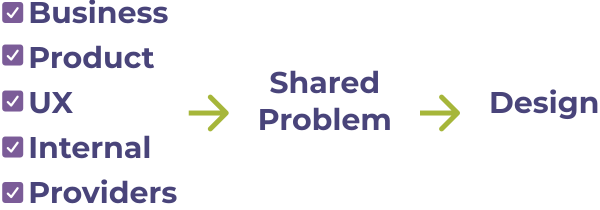
The project didn’t need another solution yet. It needed a shared understanding of the problem. Before moving into design, I proposed bringing the key perspectives together to surface assumptions, understand where their experiences differed and establish what we actually needed to solve.
A simple framework for complex perspectives
I designed and facilitated a problem-framing workshop that gave stakeholders a structured way to step outside their individual perspectives and look at the experience through the eyes of both the health plan and providers.
Using a simple framework — I am / I’m trying to / But / Because / Which makes me feel — we worked through goals, barriers, underlying causes and the emotional impact of the experience. The whiteboard captured the conversation as it happened: different perspectives, questions, assumptions and areas where we needed greater understanding.


After the workshop, I synthesized the raw input into clear problem statements, organizing what we learned into a more focused artifact the UX and product teams could use to align around the problems we needed to solve and identify where additional research was needed.


From alignment to action
The workshop gave the UX team a shared foundation for moving forward and surfaced two important needs. First, we needed a deeper understanding of the very different providers we were designing for, which led to the development of provider personas.
It also reinforced that the product alone couldn’t solve the adoption challenge. Because the experience would live within an existing platform, communication and marketing would play an important role in helping providers understand what was available, why it mattered and how to find it.